

Sport as a Life Project
posted on: February 23, 2023
author: Brian Lomax, Ed.D.
As a human being, there are many activities that you engage in each day and week. You may be a student and attend classes on a regular basis. Or perhaps you have a job/career that demands many hours per week. Playing a musical instrument could be a passion. If you are reading this, you are probably an athlete.
When you examine all of the activities in your life, which are most important to you? Do you have a structured approach to your performance in these areas? One way to help you clarify and organize your passionate pursuits is to think of each one as a life project. In fact, you could (and should) view your life as a collection of life projects.
Conceptualizing something like your sport or your career as a life project can be very helpful because if you are like most people, you strive to do your best on projects that you choose. And because you want to do well, looking at your life as a number of projects will bring perspective and structure to your pursuits. The purpose of each project in your life will become clearer.
What is a Life Project?
The concept of a life project is a core tenet of existential philosophy. The existential perspective states that if you wish to live a meaningful and authentic life as an individual, you should fully engage with projects that are important to you. That is how you express your true self in the world. You commit to the projects that are important to YOU, and through full engagement with those projects, you experience meaning and fulfillment in your life.
So, what are the projects in your life that are important and meaningful to you? Tennis, school, work/career, parenting, music, volunteering, etc.? Take a moment to identify your projects and reflect on how this perspective changes your thought process.
Your Tennis Project
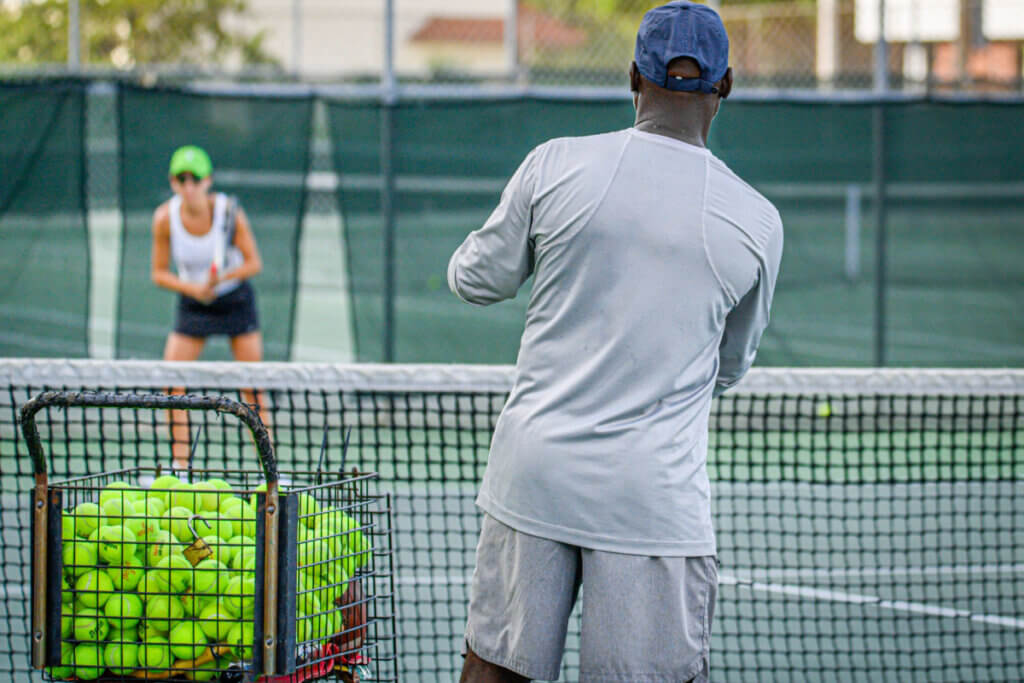
When it comes to your tennis project, it is very likely that the structure and design of it are not fully meeting your needs. That is because you have not specifically designed the project and its structure to fulfill your purpose. Instead, you probably participate in group practices and clinics, point and match play, and competitive play in tournaments and/or leagues. You engage in these activities because you have been told that this is what you should do, and since the structure is already established, it’s easy to plug into.
However, this is an established structure designed by clubs and coaches to serve the needs of many students, as well as to ensure their own economic survival. It doesn’t prioritize your needs because it’s not designed for you. It’s built for the masses.
You need to take control of your project so that the activities, and schedule of training and competition serve the needs of your game. To begin this process, determine the purpose of your project and set a vision for where you want it to go.
What Is the Purpose of Your Tennis Project?
 In my post on everything is practice, I asked you to consider making your ultimate goal “to become the best player that YOU could become.” If you love competing and challenging yourself, then this goal should resonate with you, and become your primary mission. Other outcome oriented goals, such as wins and rankings, will become measures of progress rather than primary objectives. Your self-esteem will no longer be tied to winning, UTR/NTRP, or rankings. You are humbly working on a project to be the best you can be. The most important version of you is the person you are becoming.
However, not everyone’s primary motive for playing tennis is to become the best they can be. You might play because it is a stress relief from other parts of your life, or perhaps it is a social outlet for you. Those are great reasons to play as well; not everything in life has to be about pursuing mastery.
Understanding your main motivation for playing will inform the purpose and nature of this life project. To clarify your project’s purpose, write a vision or mission statement for it. Here is an example:
“To be the best I can be by giving it my all each day, embracing the challenge of learning and improving, and being proud of the actions that I take.”
This simple example contains key components for the project: effort, embracing challenge, learning, improving, pride/self-satisfaction, and action. What are some key components for your project that you can include in the vision statement?
Developing Your Project Plan
In my previous career in the technology sector, I created and utilized project plans frequently, and developed expertise in breaking down projects into component parts and tasks. Developing a good plan is critical because it enables the project team to know what needs to be done each day and each week to achieve success. It provides clarity and confidence in the process.
You can create this same feeling of clarity and confidence for yourself by developing a project plan for your tennis project, and recruiting a great team (coach, strength trainer, sport psychology professional, manager/agent, practice partners, etc.) to help you.
To get you started, here are some high-level categories to include in your plan:
- Tennis skills
- Strategies and tactics
- Physical energy (sleep, nutrition, hydration, conditioning)
- Mental and emotional skills
- Character skills
- Equipment
- Preparation
- Inter-personal relationships
This list is not exhaustive, so you may include more categories into your plan. From this point, look at each category and consider what needs work over the next few months. Collaborate with your coach to prioritize your efforts on and off the court. And consider maximizing your strengths as an integral part of the project.
Continue to refine your project plan until you feel confident that you know what you are doing each day and each week to make progress toward your goal. At the end of every week, you should feel that you are closing the gap between who you are today and the best version of you in the future.
Although your daily and weekly plan will facilitate your learning and improvement, you will need to monitor your progress along the journey. Review your project plan each week to see how you’re doing and determine if any adjustments should be made.

Your Workshop
 Now that you have your project plan in place, it’s time to look at the tennis court a bit differently. Think of the court as your workshop; it’s the place to refine and improve your tools and weapons. It is the place to develop mastery. Your Vision Statement will be realized by going to work in your workshop.
What are your tools and weapons? Your strokes, your footwork, your mental and competitive skills, your character skills, etc. The high-level categories in your project plan will have more details on the specifics of your tools and weapons.
When you go to work in your workshop, it is not about proving that you are a good player. It is about identifying a skill (tool) that you want to improve, and working on it in a non-judgmental way so that when you leave the workshop, you feel satisfied that you made progress with that skill. This approach can be a great source of enjoyment and pride.
But your workshop is not just on the practice court. You need to view the competition court as your workshop as well. There are many skills, tools, and weapons that need practice and refinement on the competition court. Use your plan as a source of courage and commitment when competing so that you leave the court 1% better than when you entered it.
Conclusion
Treating sport as a life project to pursue with passion and meaning is a perspective that can change your life. You will be able to detach yourself from wins and losses more easily, and instead, remain focused on fulfilling your vision. You will learn to prioritize who you are becoming over who you are in the present, or who you were in the past. THAT is a journey worth pursuing.
Follow PerformanceXtra



Share This Post


About the Author
Dr. Brian Lomax founded PerformanceXtra™ in 2009 with a mission of helping athletes achieve their goals and their top performances more consistently through a progression of mental skills that enables them to focus on what is truly important.
Learn more about the author: https://performancextra.com/brian-lomax/
6 responses to “Sport as a Life Project”
Leave a Reply
774.285.4179
PerformanceXtra™ © 2026 All rights reserved
Follow PerformanceXtra
Share This Post
web design by: Gordon Multimedia
Fabulous article helping us to reframe the way we see our progress as being more of an individual, tailored process. This makes the “project” have more intention instead of floating through drills and matches mindlessly. Great explanation.
Thank you so much!
Thank you, Kristen! I am glad you enjoyed this perspective, and I hope those that you work with can learn to view their tennis as a project. 🙂
Love this perspective and all of the practical information to get there. As always, life lessons and tennis lessons in one great post.
Thank you, Jill! I hope you are doing well!
Your arguments make total sense, and yet for all of us (at least some of the time), taking responsibility for what we truly want is frightening to the point of incapacity. This is why spectating has become big business. I would write more, but I have to get back to my project(s) of encouraging folks to sign up for their projects.
Thanks for your spot-on perspective.
Haha! Thank you, Dennis! I hope you are well.