

Continuing to Believe in Yourself When You Aren’t Getting Results
posted on: August 4, 2023
author: Brian Lomax, Ed.D.
The reality of tennis is that you will lose. Points, games, sets, and matches: you will lose all of these during your tennis career. Dealing with loss comprises a large part of the tennis player’s journey, and there is a level of suffering associated with all of this losing. Putting these experiences into perspective becomes important because it is very easy to lose faith in yourself and what you are doing. Amidst all of this losing, how can you continue to believe in yourself? How can you continue to trust your system of playing and training when you aren’t getting the results you want or the results that you think you deserve?
“…one of the difficulties for any player, is continuing to believe in yourself even when you aren’t getting the results you want.”
-Helen Emms, from Achieving Peak Performance in Tennis
This Is Hard
To be brutally honest, this is really hard. Tennis is a cruel sport. You can do all of the right things in training, preparation, and in a match, and still lose. Maybe you do all of the right things, and then you play poorly. These experiences are not pleasant, and even though you are doing all of the right things, your criteria for success at the end of the day is probably based on whether you won or not. If you lose a few times in a row, then the fact that you have been doing all of the right things carries less weight. It’s not a consolation for losing. Like, “Who cares if I’m doing all of the right things, I’m losing matches!” This might be the moment when you start to question what you are doing, and perhaps even question whether you are a good player or not. Is it time to quit?

Winning Lags Behind Positive Behaviors
Elite tennis coach, David Sammel, noted that he has seen a number of players quit the professional tour just at the moment in which he thought they were about to make a breakthrough. Although there could be a number of reasons why players discontinue their tennis journeys, it is safe to say, I think, that if they were winning, they wouldn’t be quitting. So, results play a part in how tennis players evaluate their success, but the problem with that criteria is that winning is a lag measure, meaning that it lags behind all of the good stuff you are doing in training, preparation, routines, point construction, mental training, strength training, etc. How far it lags behind is uncertain, and that is part of the issue. No one actually knows when those positive behaviors will translate into better and sustained results. It could take months; it could take years. It’s much easier to question yourself and your process, which will only lead to struggling more and for longer.
Just so you know, if you’re struggling to see the benefits of your training, you’re in good company. Every single great tennis player has had to make this journey. They have all had to learn to trust themselves more and believe in themselves more. Part of that journey is redefining personal satisfaction after a match. The best players in the world understand that personal satisfaction comes from playing with great attitude, great effort, and a feeling that you did everything you could to win the match. What more can you ask for?
Self-belief and Trust
Nearly everyone understands that self-belief and trust (confidence) are important components of performance, but they might actually be more important than you think. As an example, let’s say you were up 5-4 in a set, and you choked it away, and lost 7-5. What happened there? Well, you might have noted that you were thinking more about protecting your lead, you got tight, you played tentatively or too aggressively, hoped the opponent would miss, you froze, etc. This probably sounds familiar.
The Stress of the Situation Can Change You
 But let’s look at this situation through the lens of trust and belief. In a big moment in the match, maybe you let the circumstances of the situation change how you play. Even though your game got you to a winning position, perhaps you didn’t trust it to finish the set for you. You (unknowingly) went away from that game, and you no longer were doing the right things or making good decisions. It’s possible that you didn’t believe in yourself enough to finish the set. This is what tennis does to everyone. The stress of the situation challenges your trust and belief in your game and yourself, and it tricks you into losing.
Now, you’re upset that you lost because you believe that you have been doing everything right in training and preparation, but you’re not seeing the results. However, maybe you’re not doing everything right in the match. Under pressure, perhaps you’re deviating from your best game. You probably have a great game, but you aren’t using it to its fullest when you need it the most. For some reason, you don’t fully trust that it will work when the outcome is on the line.
Believe in your “A” Game
The reality is that you probably never thought of the situation this way. Mental coaches will often talk about loss aversion (focusing on what you have to lose in a situation such as your lead), the difference between playing not to lose and playing to win, channeling nerves into excitement, embracing the challenge, etc. These are all valid talking points, and I discuss these with players too. But as a tennis player, one of the main components of your tennis project is to develop your “A” game – a blend of your strengths, preferred style of play, and shot selection. Your goal with this “A” game is to learn to use it all the time, no matter what the score is, and truly trust it.
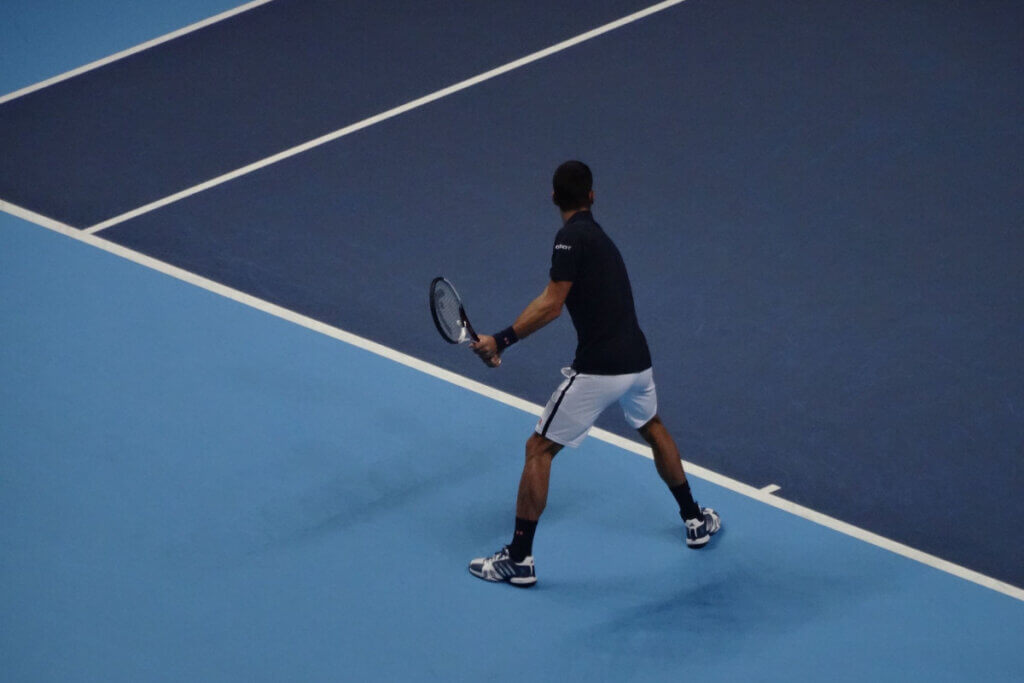
To see a great example of this, watch Novak Djokovic. He plays an extremely disciplined game, and he plays it all of the time. That’s why he is so hard to beat. No matter the score in a match, he does what he does, and sometimes he gets so locked in that he does it even better. When other players face Djokovic and the match gets tight, they tend to lose faith in their games. They make errors, and Djokovic wins. The only player on the ATP Tour at this moment in time who doesn’t lose faith in his game under pressure vs. Djokovic is Carlos Alcaraz. The rest of the men’s field struggles to trust their games to deliver in the pressure moments against this one special player.
Your Challenge
The challenge for you is to develop that “A” game and learn to trust it. Your “A” game also includes your attitude, effort, and fighting spirit. Be sure to include those components into your approach.
When you struggle under stress, realize that it is a sign that you don’t trust and believe in the “A” game enough. Next time you face a stressful situation, exhort yourself to believe more and trust your “A” game more. Do your best to have the experience and learn from it. Your tennis project is one of experimentation and learning. What do you have to lose?
Doing everything right in training, practice, and preparation is a great foundation for success. However, you have to go one step further and learn to do everything right during the performance. The more that you believe in yourself and your game in a match, the more you will be able to say that, “I’m doing all the right things.”
Follow PerformanceXtra



Share This Post


About the Author
Dr. Brian Lomax founded PerformanceXtra™ in 2009 with a mission of helping athletes achieve their goals and their top performances more consistently through a progression of mental skills that enables them to focus on what is truly important.
Learn more about the author: https://performancextra.com/brian-lomax/
2 responses to “Continuing to Believe in Yourself When You Aren’t Getting Results”
Leave a Reply
774.285.4179
PerformanceXtra™ © 2026 All rights reserved
Follow PerformanceXtra
Share This Post
web design by: Gordon Multimedia
As a senior player, I vividly remember giving into my ‘fear of losing’ as a junior. While I had the strokes, athletic talent and moxy to succeed at the highest regional/sectional level, I failed to compete with the topped ranked juniors who were selected for national USTA tournaments. Now looking back more than 50 years, I realize anxiety was my biggest hurdle in junior tennis. I still don’t know the source. Today, I am enjoying the game more than ever and could care less about the outcome of matches. I wish this was the situation when I was 15 years old.
Great article! You have to trust yourself or as Darren Cahill says “be willing to back yourself in the big moments and play to win. Self belief and confidence goes a very long way, especially as the stage gets bigger and the moment more important!!
As usual Brian, very eloquently written!!