

Learning to Finish Matches
posted on: November 8, 2023
author: Brian Lomax, Ed.D.
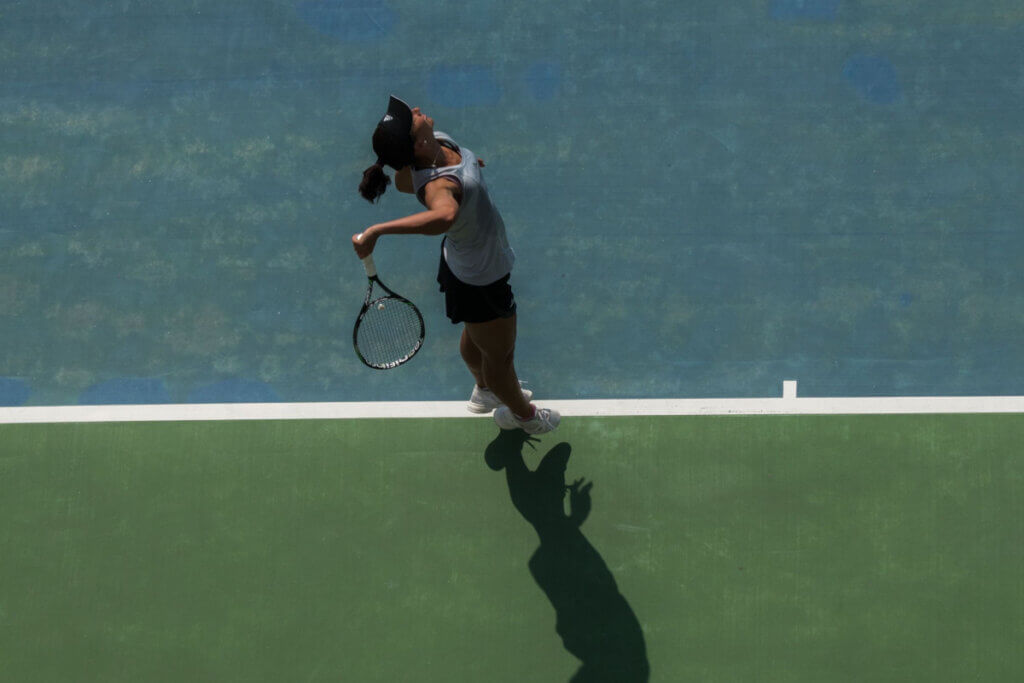
One of the many difficult challenges in the sport of tennis is the concept of finishing. Finishing a point; finishing a game; finishing a set; and of course the ultimate challenge, finishing a match.
If you want to win more matches, you must learn to finish. There is no clock at the end of the match to save you and make it easier. You can’t coast until time runs out. You have to work for the result and do your best to earn it. If you don’t, the opponent can snatch it away from you – the point, the game, the set, or even the match. Knowing how to finish is one of the greatest and toughest skills in the sport of tennis.
Practicing How to Finish
How do you learn to master this skill? Naturally, it takes practice. And like anything we practice, we want to do it to the point that the skill becomes second nature.
But many people don’t practice finishing with this kind of intention. They don’t train it as if it were a process that involves a number of other physical and mental skills. Instead, they practice more basic skills like technique and consistency. Of course, those skills are necessary to be a good tennis player, but there is so much more to finishing a match than knowing how to hit a ball.
You need to know how to combine basic skills with good decision making, a good game plan, and a solid mental approach in pressure moments with intention, and forethought.
The Components of Finishing Well
There are several components to being a good finisher in tennis and they are a blend of the physical, mental, and emotional skills. Below are a few to consider.

Perspective
When you find yourself in a finishing situation, realize that it is an opportunity to achieve something, not to lose something. It is an opportunity that you have earned, and now is the time to embrace that opportunity.
Challenge yourself to bring your best tennis to the moment. Challenge yourself to continue to play the way you have been playing to arrive at this moment.
Even if you don’t succeed, you can be content that you attempted to play the right way to finish the match, and that will help you to learn for the next time. The next time might be in the next game or two.
I have witnessed a number of players try to close out a match at 5-2, lose the next two games, and then finish the match well to win 6-4. Losing the game at 5-2 was, in essence, practice for the next opportunity. By having a good perspective for finishing sets and matches, you substantially increase your chances of success.
Of course, there are barriers that you may face in this process. You may start to focus on protecting your lead which will lead to playing tentatively. Or perhaps you have a history of struggling in closing situations, and that history is too present in your mind. It’s useful to understand your unique difficulties with closing so that you can address them in productive ways, and design perspectives and behaviors to navigate around them.

Emotions
Adopting a positive and productive perspective toward finishing situations will help you to construct emotions to facilitate good performance. To understand this better, you must realize that emotions are not a reaction to what has already happened. Rather, your brain is a prediction machine, and depending on what the brain is predicting in a specific situation, it will construct the emotions that are necessary to respond.
Believing that a finishing situation is an opportunity, not a threat, should help you to construct the emotions that YOU need to perform well in this moment. Do you know what those emotions are for you? Take a moment to consider which emotions bring out your best tennis. Can you pair those emotions with a mindset or perspective?

Discipline and Intention
Finishing situations are often viewed as pressure moments, and this may cause you to feel stressed. When you have a negative perception of stress and pressure, you are more likely to make poor decisions, and you eventually beat yourself. The moment can be so uncomfortable that you find yourself rushing and wanting to end points quickly.
The result of this type of thinking is that you lose games rapidly. However, your perspective and emotions can help you to reduce feelings of stress, and to think more clearly.
When you are thinking more clearly, you can commit to executing your game plan in a very disciplined way. Use the patterns of shots and targets that have brought you to this moment. Hit good shots.
(What is a good shot? Master Professional Bill Tym defines a good shot as “a high percentage shot that goes to the right spot at the right time, and either wins or contributes to winning the point.” )
Take your time between points, and be disciplined with your routine. Try your best to simply play one point at a time.

Body Awareness
To perform your best under pressure, you must bring awareness to how your body is feeling in that moment. Many players react to pressure by tightening up, breathing more rapidly and shallowly, and gripping the racquet more tightly.
These physical reactions rarely produce good performance, so you must work on making yourself feel better in a finishing moment.
Slow your breathing and breathe more deeply. Bounce up and down, and shake out your arms and legs to release tension. Notice how tightly you are holding the racquet, and try to loosen your grip. Use your body language to project some combination of confidence, calmness, and energy that works for you.
Paying attention to how your body feels, and making it feel better, will assist you in your quest to play well and finish the match. The better you feel, the better you’ll play. So, work on how you feel first, and trust that to drive the quality of your play.

Focus
In a closing situation, there are so many things that could be going through your mind, and the majority of those are probably not fully in your control. Examples are the score, what other people think, winning, etc.
Focusing on those items will hinder your ability to perform, but it’s natural to have them in your mind. When you notice that your thinking of these troublesome things, note that it is normal to do so.
However, in order to perform well, you need to bring your mind to the present and to what you can control. Examples of items in your control are attitude, effort, footwork, body language, intentional self-talk, and energy. See the discipline section above for more information on what present and controllable focus should be when finishing.
Confidence and Belief
As noted earlier, finishing matches is a skill, and therefore, building confidence around this skill is a process. It can take a lot of trial and error as well as match experience.
The more you treat finishing as a skill, and emphasize the controllable aspects of it, the better you will become at it. You will start developing your “recipe” for closing; one that you can practice, repeat, and perfect over time. However, if all you can think about is the end result, then it will take much longer to learn how to do this, and you won’t trust yourself in these situations.
You also want to be sure that you are approaching finishing matches with the belief that you “can” do it. Not that you “should” do it, “need” to do it, “have to” do it, or “can’t” do it.
Notice the language of your self-talk in this moment. Is it rational? Is it correct? Productive self-talk can help you to realize that you are in a positive situation, and that you absolutely have the ability to win.
If you use this voice to produce positive/productive emotions, and positive actions, you will have a much better chance of success. Repeating this process in training and matches will build confidence in your ability to finish.

Resilience
Another difficult aspect of tennis is that you can do all of the right things on the court, and still lose. This happens at every level of the game, so to a certain extent, it’s a normal occurrence.
The challenge is to learn from what occurred, and bounce back, whether that is in the next point, next game, next set, or next match. If you want to be a great tennis player, you have no choice in how you respond to these circumstances. You must learn, and embrace the next chance as an opportunity to get better.
Earlier, I presented a scenario in which a player lost her serve at 5-2, but then closed out the set to win 6-4. Succeeding in that manner requires resilience and mental strength. It requires the knowledge that even though you lost that 5-2 game, you are still in the set.
Players with mental fortitude understand this and they continue to compete. Less resilient players become too concerned with the score, which leads to poorer performance. If something difficult occurs, look to bounce back in the next moment, and to be present focused.
Conclusion
The tips above are meant to help you deconstruct the process of finishing sets and matches so that you can practice these components in isolation, but also together. Since this is one of the most daunting challenges in the sport, it’s wise to dedicate time to improving your finishing ability.
Follow PerformanceXtra



Share This Post


About the Author
Dr. Brian Lomax founded PerformanceXtra™ in 2009 with a mission of helping athletes achieve their goals and their top performances more consistently through a progression of mental skills that enables them to focus on what is truly important.
Learn more about the author: https://performancextra.com/brian-lomax/
Leave a Reply
774.285.4179
PerformanceXtra™ © 2026 All rights reserved
Follow PerformanceXtra
Share This Post
web design by: Gordon Multimedia